Why Minecraft Is Still the Most Popular Game in the World
Sixteen years after launch, Minecraft keeps breaking its own records. No other game in history has managed to stay this relevant for this long. Here's why.
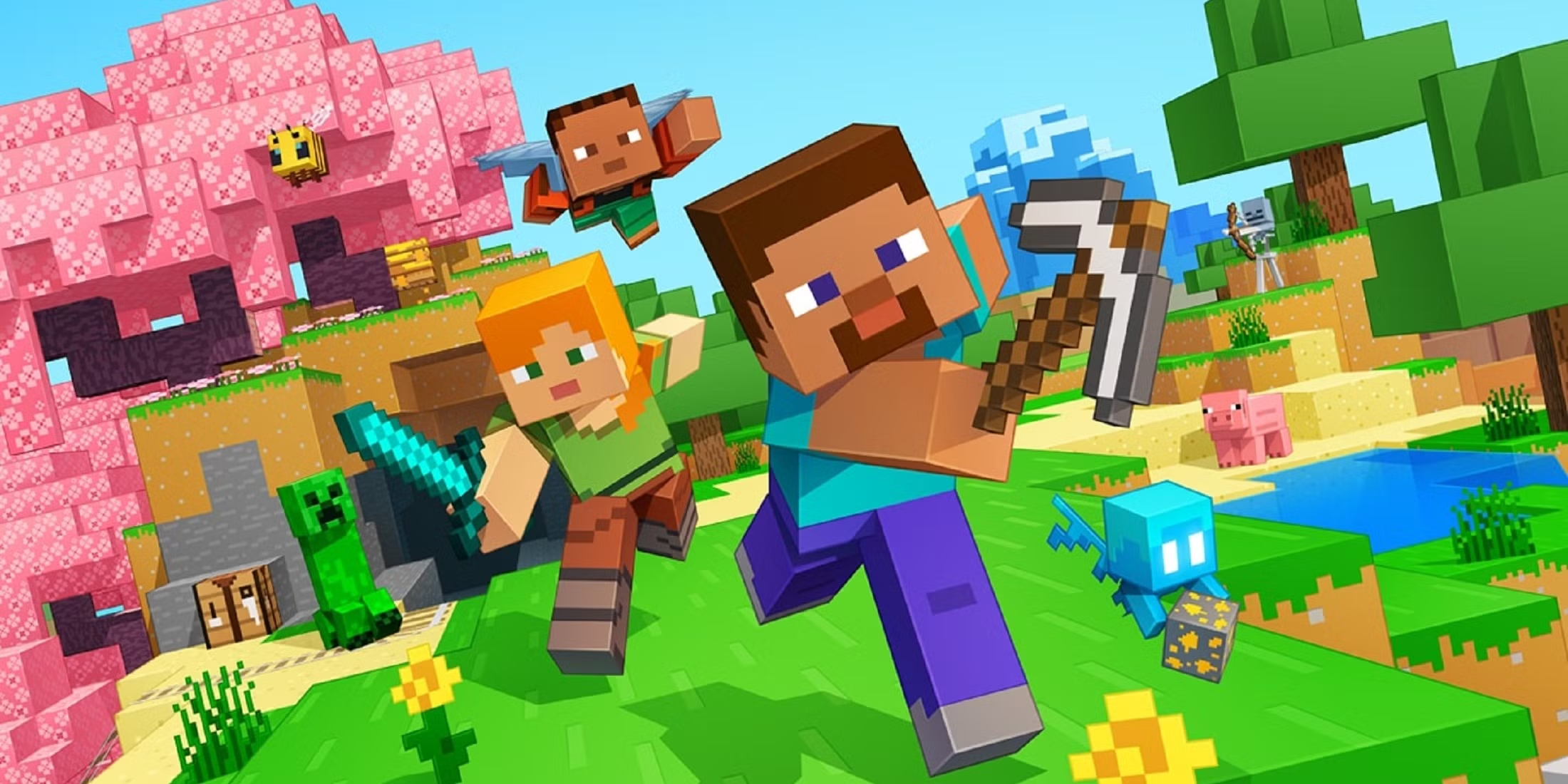
Most games have a lifecycle. They launch, peak, decline, and eventually disappear from the cultural conversation. Minecraft has defied this pattern so thoroughly and for so long that it has become something more than a game — it's infrastructure. A permanent fixture of global culture that continues to grow while everything around it rises and falls.
In 2026, Minecraft has over 170 million monthly active players. That number is not a legacy stat. It is higher than it was in 2023.
The Numbers in Context
To understand what Minecraft's staying power actually means, it helps to compare it to other massive games:
- - Fortnite peaked at around 350 million registered accounts in 2020, but monthly active players have declined significantly since
- - GTA V, one of the best-selling games ever made, has been kept alive almost entirely by GTA Online's ongoing updates
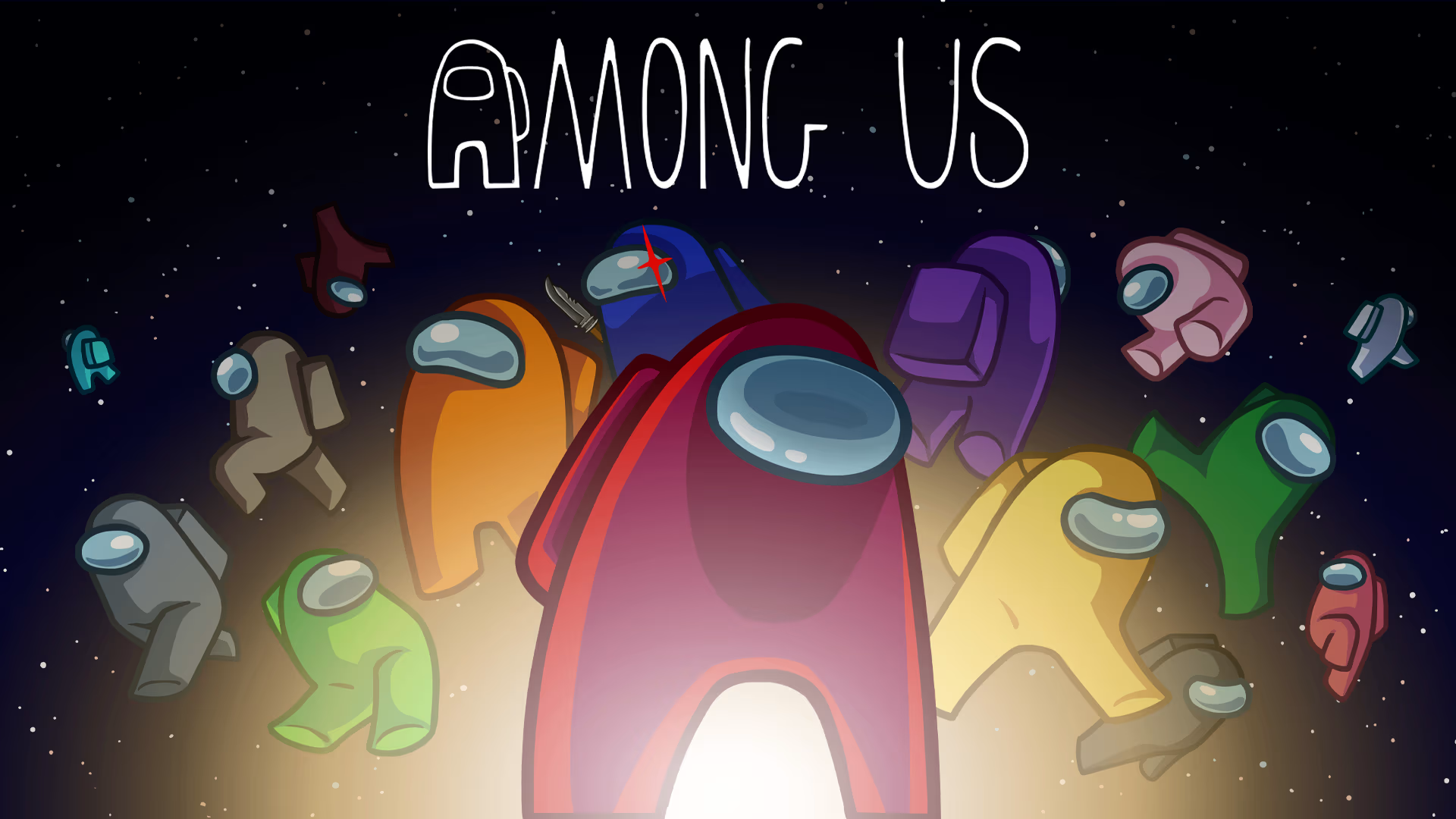
- - Among Us exploded in 2020 and was largely irrelevant by 2022
Minecraft launched in 2011. It was the best-selling game in the world in 2019. It is still in the top five in 2026. No other title in gaming history comes close to that trajectory.
It's a Platform, Not Just a Game
The most important thing to understand about Minecraft is that calling it a "game" undersells what it actually is. Minecraft is a platform — one that has hosted hundreds of millions of user-created worlds, educational programs in over 115 countries, entire server economies, and a creative community that produces more content daily than most studios produce in a year.
Mojang understood this early. Rather than controlling what players could do with the game, they built tools to expand it. The modding ecosystem alone has generated thousands of completely distinct gameplay experiences within Minecraft's framework. Players aren't just playing one game — they're choosing from an effectively infinite library built on top of one engine.
This is what separates Minecraft from competitors who have tried to replicate its success. You can copy the block aesthetic. You cannot copy fifteen years of community infrastructure.
The Education Factor
Minecraft: Education Edition is now used by over 35 million students across 190 countries. Teachers use it to explain everything from history and architecture to chemistry and coding. School systems in Sweden, Finland, and South Korea have integrated it into formal curricula.
This has a compounding effect that no marketing budget can replicate. Children who encounter Minecraft in school don't experience it as advertising — they experience it as learning. They go home and continue playing. They introduce it to siblings and parents. The game acquires new players at the youngest possible age and retains them through genuine attachment rather than habit loops or monetization mechanics.
Why Other Games Can't Kill It
Every few years, a new game is announced as the "Minecraft killer." Roblox was supposed to replace it among younger audiences. Terraria was supposed to steal its survival-sandbox players. Valheim was going to take the older demographic. None of it happened.
The reason is simple: Minecraft does not compete on any single dimension where it could be beaten. It is not trying to have the best graphics, the most sophisticated combat, or the deepest narrative. It competes on creative freedom — and on that dimension, it has an insurmountable head start. The moment a new player builds their first house, they have made something that belongs to them. That psychological ownership is extraordinarily difficult to transfer to another game.
The YouTube and Content Machine
Minecraft is consistently among the top three most-watched gaming categories on YouTube, with over 1 trillion total views as of 2025. Creators like Dream, Technoblade's legacy channel, and dozens of others built audiences of tens of millions entirely on Minecraft content.
This content pipeline functions as permanent, free advertising. New creators enter the ecosystem constantly, introducing the game to audiences who may never have encountered it otherwise. A twelve-year-old watching a Minecraft video in 2026 is experiencing the same discovery loop that drove the game's original viral growth in 2012.
Microsoft's Role
When Microsoft acquired Mojang for $2.5 billion in 2014, many predicted the acquisition would ruin the game through corporate overreach. The opposite happened. Microsoft largely left Minecraft's development culture intact while providing the infrastructure to scale globally — better servers, cross-platform play, consistent updates, and the Education Edition push.
The result is a game that has the community authenticity of an indie project and the distribution muscle of one of the largest technology companies in the world. That combination is almost impossible to replicate.
What 2026 Looks Like
The most recent major update, Minecraft 1.22, added deep ocean biomes and overhauled the game's weather systems — changes that generated more first-week player engagement than any update since Caves and Cliffs in 2021. The community response was immediate: server populations spiked, YouTube coverage exploded, and a wave of players who had drifted away returned to see what changed.
This pattern — update, return, discovery, retention — has repeated reliably for over a decade. There is no reason to believe 2027 will look different.
Minecraft is not popular despite its age. In many ways, it is popular because of it. Sixteen years of updates, community building, and cultural embedding have created something that cannot be built quickly. It had to be grown — and it still is.