How Among Us Became a Phenomenon — And Why It Disappeared Just as Fast
Among Us launched in 2018 to almost no attention. Two years later it had 500 million players. Two years after that, almost nobody was playing it. Few games in history have risen and fallen so fast.
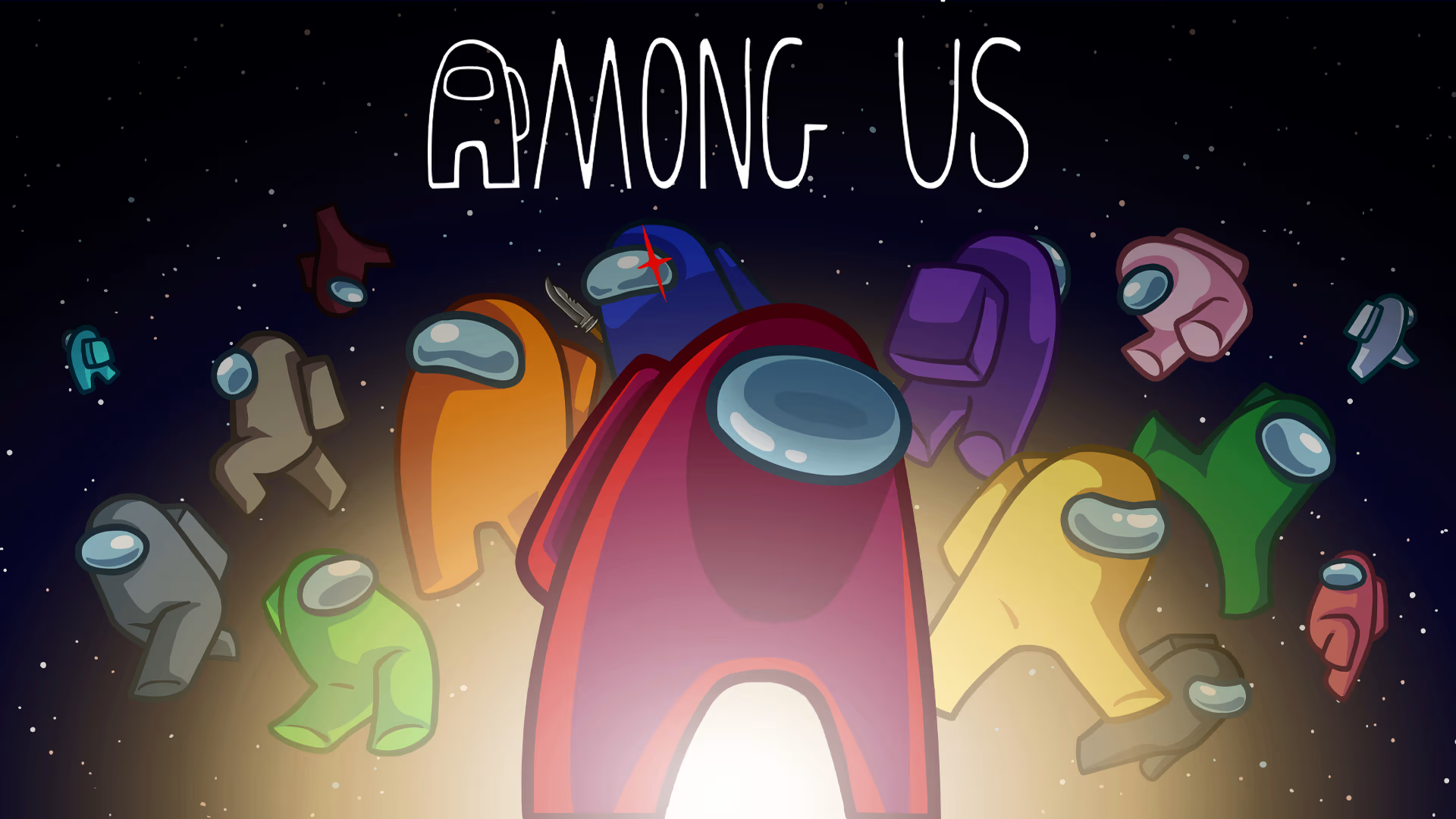
In August 2018, a small studio called InnerSloth released a mobile game called Among Us. It cost $2.99, had simple cartoon graphics, and was based on a social deduction mechanic borrowed from the party game Mafia. In its first year, it was downloaded approximately 30,000 times. By any conventional measure, it had failed.
In September 2020, Among Us had 500 million active players. It was the most downloaded mobile game in the world. The US Congress held a hearing during which Representative Alexandria Ocasio-Cortez streamed it on Twitch to 439,000 simultaneous viewers. The words "sus" and "impostor" entered mainstream vocabulary. InnerSloth, a team of four people, had accidentally created one of the most significant cultural moments in gaming history.
By late 2021, it was over. The player counts had collapsed. The cultural conversation had moved on. Among Us became a case study not just in viral success but in what happens after it.
Why Nobody Noticed It at First
Among Us spent its first two years in a state of benign neglect. InnerSloth had moved on — they were developing a sequel, Among Us 2, having largely concluded that the original game's moment had passed. The game had a small but dedicated player base, primarily in South Korea and Brazil, where word-of-mouth had created pockets of genuine community. But by Western gaming industry standards, it was invisible.
The game itself was not invisible because it was bad. It was invisible because nobody had looked at it yet. Among Us is a genuinely clever design — a social deduction game that translates the dynamics of Mafia into an interactive format with tasks, emergencies, and the specific tension of not knowing who among your friends is lying to your face. The core loop is simple enough to explain in two minutes and deep enough to sustain hundreds of sessions. The ingredients for success were always there.
What was missing was an audience.
The Pandemic and the Streamers
In March 2020, most of the world went home and stayed there. Social gatherings became impossible. The need for shared entertainment — something to do together while physically apart — became acute in ways that were genuinely new for most people.
Streaming was already large before the pandemic. It became enormous during it. Twitch viewership more than doubled between January and April 2020. People who had never watched a gaming stream before were watching them because there was nothing else that replicated the experience of watching something together with other people.
In July 2020, several prominent streamers — including Sodapoppin and later xQc, Pokimane, and others — discovered Among Us and began playing it on stream. The game was perfectly suited to streaming in ways that almost no other game was. The social deduction format meant that viewers could see information that players couldn't — you knew who the impostor was, which meant you watched every interaction with the dramatic irony of a horror movie audience watching someone walk toward the monster. Watching skilled players lie convincingly was entertaining. Watching terrible liars implode under questioning was hilarious.
Within weeks, Among Us was everywhere on Twitch. Within months, it had spread to YouTube, to TikTok, to schools, to offices, to family game nights conducted over video call. The pandemic had created a perfect distribution mechanism — everyone was online, everyone was looking for something social, and Among Us was the thing that filled that specific need at that specific moment.
InnerSloth cancelled Among Us 2 and redirected their entire team to supporting the original game. They had not anticipated any of this. Almost nobody had.
Why It Worked When It Did
Among Us succeeded in 2020 for reasons that were almost entirely external to the game itself. This is the most important thing to understand about its rise — and its fall.
The game had not changed between 2018 and 2020. The mechanics were identical. The graphics were the same. The price was the same. What changed was the context in which people encountered it — a global pandemic that created simultaneous demand for social gaming, remote connection, and streamable content, combined with an influential group of streamers who happened to discover it at the same time.
This distinction matters because it means the game's success was not the result of design genius that could be sustained. It was the result of circumstances that were temporary by definition. The pandemic would end. The streamers would move on. The cultural novelty would be exhausted. Among Us had ridden a wave that was always going to break.
The Collapse
The decline began in early 2021 and was rapid. Player counts on mobile dropped by over 80% between November 2020 and March 2021. Steam concurrent players fell from a peak of over 400,000 to under 20,000 in the same period. The Twitch viewership that had driven the initial explosion had moved to other games — Fall Guys for a while, then Rust, then whatever was generating the most drama that week.
Several factors accelerated the inevitable.
The game's content had not grown to match its audience. InnerSloth was a four-person studio that had been overwhelmed by success. They couldn't ship new maps, new roles, or new mechanics fast enough to keep pace with an audience that had already exhausted the core experience. Among Us is not a deep game — it is a brilliantly simple game, and brilliant simplicity has a shorter shelf life than complexity. Once you have played enough sessions to understand every social dynamic the game can produce, there is less reason to return.
The cultural moment also had a specific relationship with novelty that worked against longevity. Among Us spread partly because it was a shared reference — saying "sus" was funny because everyone knew what it meant, and knowing what it meant was itself new. Once the reference became universal, the novelty of the shared vocabulary disappeared. The thing that made it culturally sticky became evidence that the moment had passed.
Imitators arrived too. Fall Guys, which launched in August 2020 and briefly overtook Among Us in cultural prominence, demonstrated that the audience's attention was available to other games. The social deduction space attracted competitors. The specific gravitational pull of Among Us weakened as the space around it became more crowded.
What InnerSloth Did Next
The studio's response to the collapse was methodical rather than panicked. They used the revenue generated during the boom to hire additional developers and begin building out the content that had been impossible to deliver during the initial explosion — new maps, new roles like the Shapeshifter and Scientist, visual cosmetics, and eventually a full account system.
These updates arrived too late to reverse the decline but were sufficient to maintain a smaller, stable player base. Among Us in 2026 is not a dead game — it has a consistent community, active servers, and regular updates. It occupies a position similar to games like Town of Salem and other social deduction titles: beloved by a dedicated audience, invisible to mainstream gaming discourse.
InnerSloth has also been transparent about the experience in ways that are unusual for a studio. In interviews, the team has discussed openly what it was like to be four people trying to serve 500 million players with no infrastructure, no support staff, and no preparation. The honesty is refreshing and reveals something important: Among Us's success was as overwhelming for its creators as its failure was predictable.
What Among Us Actually Was
The temptation is to read Among Us as a story about a game that succeeded and then failed. The more accurate reading is that it was a cultural event that happened to be a game.
The 500 million players who downloaded Among Us in 2020 were not primarily motivated by a desire to play a social deduction game. They were motivated by a desire to participate in something shared — a cultural moment, a common language, a way of being together while apart. Among Us was the vessel that moment happened to arrive in. When the moment passed, the vessel was no longer needed at scale.
This is not a criticism of the game. It is a description of what viral cultural phenomena are. They are specific responses to specific conditions that produce specific needs. The Beatles were not just a band — they were a response to the cultural conditions of the early 1960s. Gangnam Style was not just a song. Among Us was not just a game.
The games that sustain themselves over years — Minecraft, GTA Online, Fortnite — do so because they offer something that renews itself: a creative sandbox, an evolving world, a competitive skill ceiling. Among Us offered a single, elegant, finite experience. When that experience had been consumed by everyone who wanted it, there was nothing left to sustain the scale.
That is not a failure. Producing a cultural moment that 500 million people participated in simultaneously is an achievement so rare that most studios spend entire careers trying and failing to replicate it.
Among Us didn't disappear. It returned to its natural size. The extraordinary part was never that it fell — it was that it rose at all.