How Baldur's Gate 3 Proved That RPGs Don't Need to Be Dumbed Down
For years, publishers insisted that deep, complex RPGs couldn't sell. Then Larian Studios released a game with 174 hours of content, full Dungeons & Dragons rules, and no handholding — and it became one of the best-selling games in history.
There is a conversation that has happened in game publisher boardrooms, repeatedly, for approximately twenty years. It goes something like this: players want accessible games. Complex systems drive away casual audiences. If you want to sell ten million copies, you need to simplify.
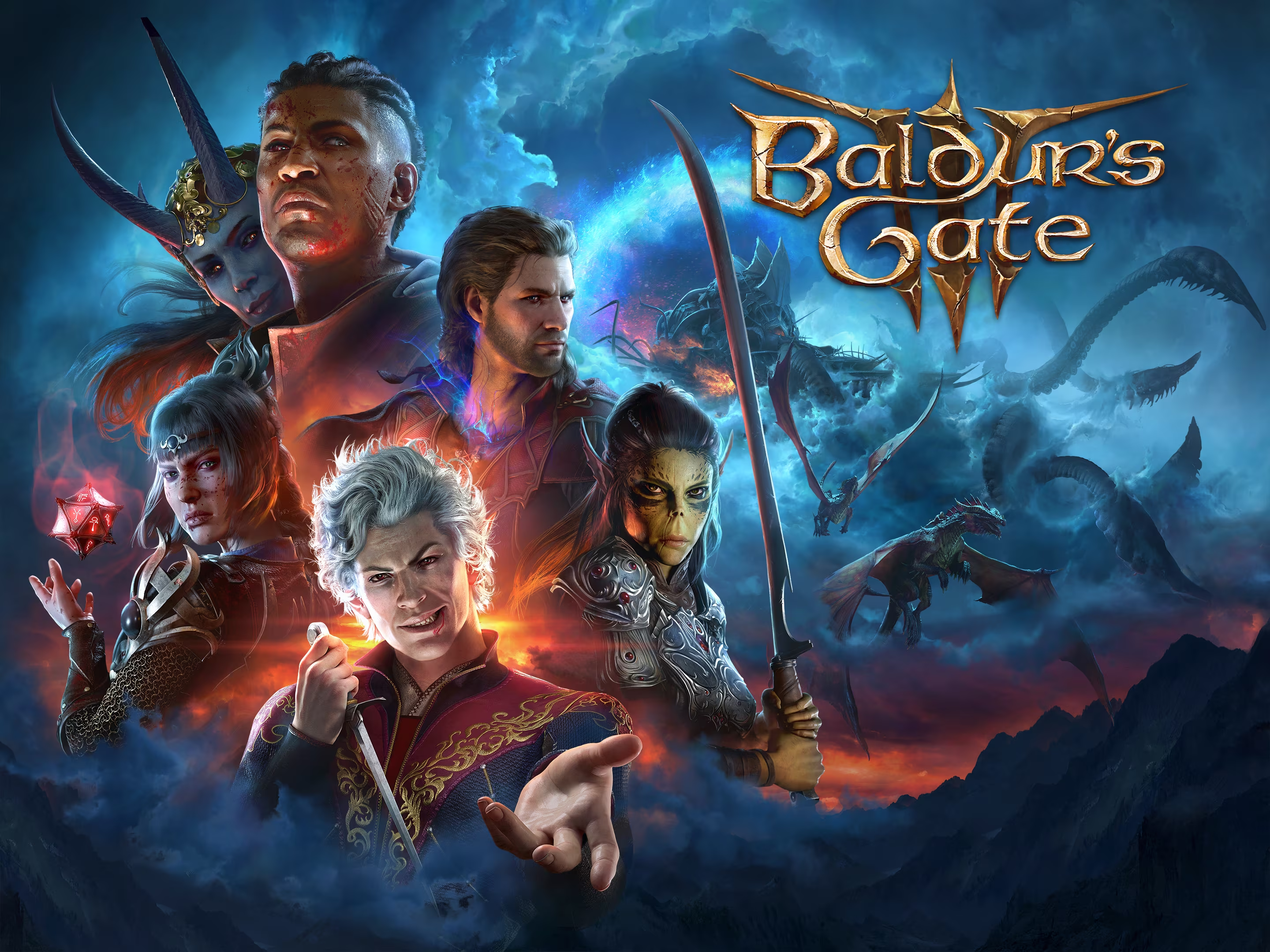
Baldur's Gate 3 sold ten million copies. It did not simplify.
Larian Studios' RPG is built on the full ruleset of Dungeons & Dragons 5th Edition — a tabletop system with hundreds of spells, dozens of character classes and subclasses, action economy rules, concentration mechanics, saving throw proficiencies, and enough depth that dedicated players spend years mastering it. The game does not apologize for any of this. It does not hide the numbers. It does not streamline the decisions. It trusts the player completely.
The result was the most acclaimed game of 2023, winner of every major Game of the Year award, and a commercial success that embarrassed titles with three times its marketing budget. The boardroom conversation has not gone away — but it has become considerably harder to have with a straight face.
What the Industry Actually Believed
To understand why Baldur's Gate 3 mattered, it helps to understand the prevailing wisdom it contradicted.
Through the 2010s, the dominant trend in RPG design was toward accessibility. Mass Effect replaced complex stats with streamlined shooting. Dragon Age: Inquisition moved away from the tactical depth of Origins toward a more action-oriented system. Bethesda's Fallout 4 reduced dialogue options to four buttons and stripped the RPG mechanics that defined earlier entries. Each of these decisions was made deliberately, justified by the logic that complexity was a barrier to mainstream success.
The data seemed to support it. Pillars of Eternity, Torment: Tides of Numenera, and Pathfinder: Kingmaker — all deeply complex, systems-heavy RPGs — sold respectably but never broke through to mainstream audiences. Publishers looked at those numbers and concluded that the hardcore RPG audience was simply too small to justify the investment.
What they missed was that those games weren't failing because they were complex. They were failing for other reasons — scope, bugs, marketing, execution. The complexity was not the problem.
What Larian Actually Built
Baldur's Gate 3 spent three years in early access before its full release in August 2023. During that period, Larian was publicly iterating — adding content, fixing systems, responding to player feedback with unusual transparency. By the time the full game launched, it had been stress-tested by millions of players who had already demonstrated that the complexity wasn't driving them away. It was pulling them in.
The numbers that define the game's scope are worth stating plainly. The main campaign contains approximately 174 hours of content if you explore thoroughly. There are twelve origin characters, each with unique dialogue and perspective on the story. The game contains over 17,000 unique dialogue lines recorded by a cast of hundreds. Every major decision branches in ways that affect not just the immediate scene but characters, relationships, and outcomes dozens of hours later.
And underneath all of that is a faithful implementation of D&D 5e rules — a system complex enough that Wizards of the Coast publishes a 300-page manual to explain it.
Why Complexity Was the Point
The insight Larian had — and that the industry missed — is that complexity and accessibility are not opposites. They operate on different axes entirely.
Baldur's Gate 3 is not accessible in the sense of being easy to master. It is accessible in the sense of being legible. Every rule is explained when it becomes relevant. Every dice roll is visible, with the modifiers that produced it shown clearly. The game never hides its mechanics — it displays them with complete transparency, trusting that players who want to understand them will, and that players who don't can still enjoy the results.
This is a fundamentally different philosophy from simplification. Simplification removes depth to reduce the learning curve. Legibility preserves depth while reducing the friction of engaging with it. Larian chose legibility, and it worked because players — given the choice between a system they can understand and a system that has been removed — will almost always prefer understanding.
The game also benefits from the cultural moment around D&D itself. The tabletop game experienced a significant revival through the 2010s, driven largely by actual-play shows like Critical Role, which peaked at millions of viewers per episode. A substantial portion of Baldur's Gate 3's audience arrived already familiar with D&D mechanics — not experts, but people who understood what an attack roll was and why spell slots mattered. The complexity that would have been alienating to a cold audience was familiar, even nostalgic, to this one.
The Critical Response and What It Revealed
Baldur's Gate 3 received a Metacritic score of 96 — among the highest ever recorded for a PC game. But the nature of the critical praise was as revealing as its volume.
Reviewers did not praise the game despite its complexity. They praised it because of its complexity. The things critics cited most frequently — the reactivity of the world, the consequences of choices, the depth of character interaction, the emergent storytelling that arose from combining systems — are all downstream of the decision to build a deep, uncompromising RPG rather than a streamlined one.
Simplified RPGs produce stories that feel authored. You make choices from a menu and receive the outcome the developers planned. Complex RPGs produce stories that feel discovered. You combine systems in ways the developers may not have anticipated and arrive somewhere genuinely unexpected. That second experience is what players described when they talked about Baldur's Gate 3 — not the story Larian told them, but the story that emerged from their specific combination of choices, classes, companions, and decisions.
No amount of polish or production value can manufacture that experience. It requires depth.
What Publishers Did Next
The industry's response to Baldur's Gate 3's success has been cautious in ways that reveal how deeply the simplification instinct runs.
No major publisher immediately announced a complex, systems-heavy RPG in response. The more common reaction was to note that Larian is a privately held studio — not accountable to quarterly earnings — and that their development timeline and budget structure are difficult to replicate under public company constraints. This is true, and it is also convenient.
What has changed is subtler. Several studios that had been quietly moving toward more action-oriented RPG designs have slowed or reversed that direction. BioWare, whose Dragon Age: The Veilguard had already launched by the time BG3's full impact was felt, is reportedly taking a more systems-focused approach to its next project. Obsidian, which had been producing accessible RPGs for Game Pass, has discussed returning to the complexity level of Pillars of Eternity.
The industry is not sprinting toward complexity. But it has stopped sprinting away from it.
The Argument Baldur's Gate 3 Actually Made
The game's commercial success proved one thing with unusual clarity: there is a massive, underserved audience for deep, complex, uncompromising RPGs.
That audience was always there. It was not too small. It was not too niche. It was not unwilling to engage with systems and rules and consequences. It was simply not being given games that respected its appetite for depth.
When Larian gave it one — a fully realized, deeply complex RPG built without apology and without compromise — that audience responded with ten million purchases, thousands of hours of content creation, and a cultural conversation that lasted well into 2024.
The lesson is not that every game should be complex. It is that complexity, executed with craft and presented with clarity, is not the commercial liability the industry spent twenty years treating it as.
Players are not afraid of depth. They are afraid of depth that is poorly explained, arbitrarily punishing, or unrewarding. Baldur's Gate 3 was none of those things. And the market made its opinion clear.