How Fortnite Changed the Gaming Industry — And What Comes Next
When Fortnite launched its battle royale mode in 2017, nobody predicted it would rewrite the rules of an entire industry. Eight years later, its fingerprints are everywhere.
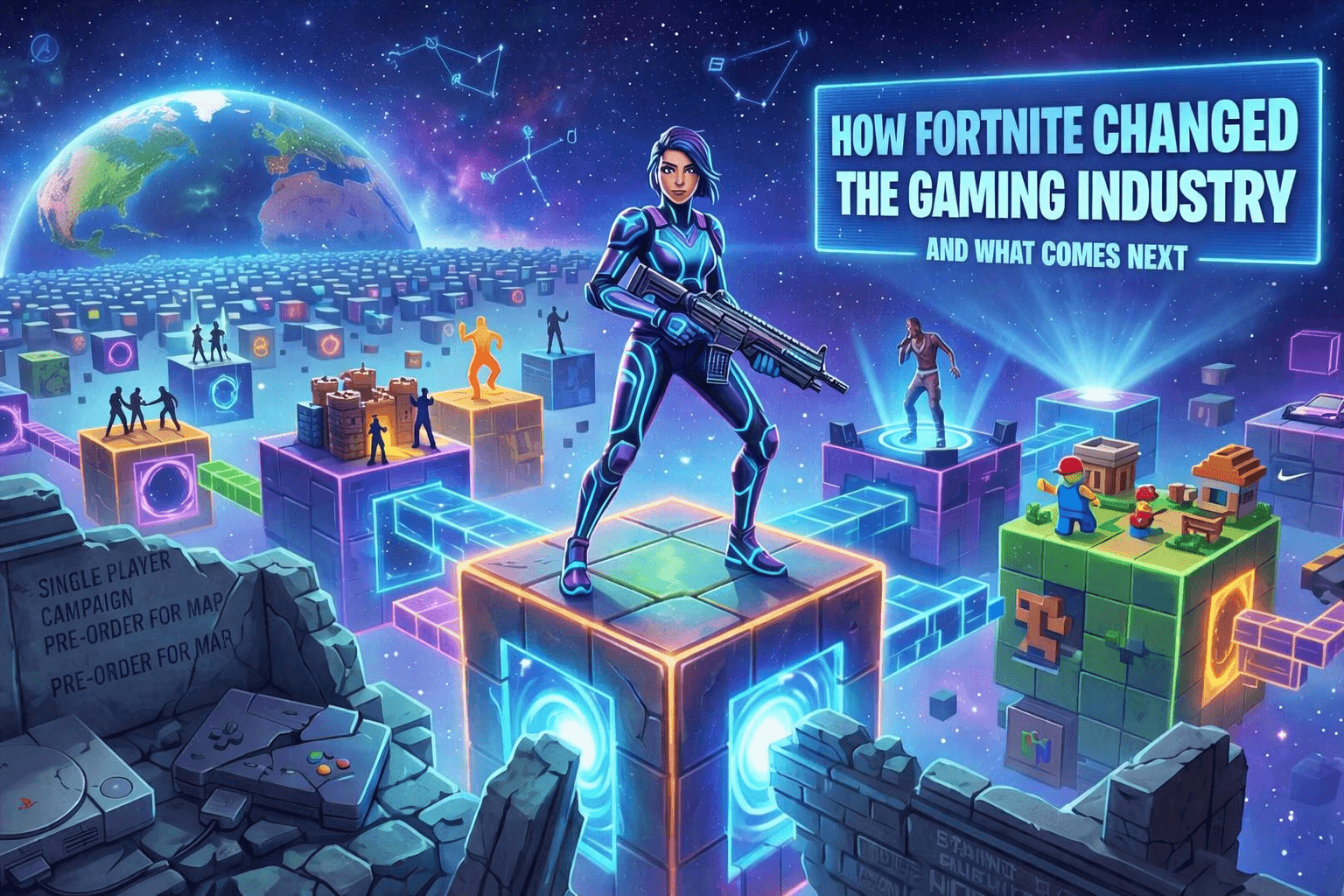
There is a clear dividing line in modern gaming history: before Fortnite and after Fortnite. The game didn't just become popular — it fundamentally altered how games are designed, monetized, marketed, and thought about at the executive level. Understanding what Fortnite did is essentially understanding the past eight years of the industry.
The Battle Royale Wasn't Even the Point
Fortnite launched in July 2017 as a cooperative survival game called Save the World. It was moderately successful and largely unremarkable. Two months later, Epic Games released a free battle royale mode almost as an afterthought — a direct response to PUBG's explosive growth.
Within six months, Fortnite Battle Royale had 45 million players. Within a year, it had 125 million. Epic had accidentally — or brilliantly — stumbled onto something that would reshape the entire medium.
What Fortnite Actually Changed
The most obvious legacy is the battle royale genre itself. Within 18 months of Fortnite's explosion, virtually every major publisher had either released or announced a battle royale mode. Call of Duty launched Warzone. EA built Apex Legends. Battlefield V added a battle royale. Even games with no logical reason to include the format were shoehorned into it.
But the genre itself was almost secondary to what Fortnite proved about monetization.
Before Fortnite, the dominant model for multiplayer games was either a one-time purchase or a monthly subscription. Fortnite made the game itself free and charged exclusively for cosmetics — skins, emotes, gliders that had zero impact on gameplay. The battle pass, introduced in Season 2, gave players a structured progression system that refreshed every few months and generated consistent, predictable revenue.
The results were staggering. Epic reported $9 billion in revenue in 2018 and 2019 combined. Publishers across the industry looked at those numbers and immediately began restructuring their monetization strategies. The battle pass is now standard across dozens of games that had nothing to do with Fortnite's genre or audience.
The Cultural Moves Nobody Expected
What separated Fortnite from every competitor that tried to replicate it was Epic's understanding that the game was a social space, not just a product.
The Travis Scott concert held inside Fortnite in April 2020 was attended by 12.3 million players simultaneously. It was not a promotional gimmick — it was a genuine cultural event, covered by mainstream press that had never written about a video game before. Epic followed it with concerts from Ariana Grande, J Balvin, and others, and with brand collaborations spanning Marvel, Star Wars, Nike, Ferrari, and Balenciaga.
These weren't just licensing deals. They were signals that Fortnite was positioning itself as a platform — a persistent virtual space where culture happened — rather than a game with a limited shelf life. Epic CEO Tim Sweeney had been openly discussing the metaverse concept for years before the word became fashionable. Fortnite was his proof of concept.
The Casualties
Fortnite's success left significant collateral damage across the industry.
The most direct victims were mid-budget multiplayer games that couldn't compete with free. Titles with $30–50 price tags and reasonable player counts found their audiences evaporating as players consolidated around free-to-play options. Several studios shut down or pivoted entirely after failing to compete in a market Fortnite had repriced to zero.
The battle pass model, while profitable for those who executed it well, also created a treadmill dynamic that many players and developers found exhausting. The pressure to release consistent seasonal content burned out development teams at studios that weren't built for live-service operations. The failure of Anthem, Babylon's Fall, and Suicide Squad: Kill the Justice League can all be traced in part to publishers chasing Fortnite's model without Fortnite's infrastructure or player base.
Where Fortnite Stands in 2026
Fortnite has now been in its "Chapter" era for several years, continuously reinventing its map, mechanics, and collaborations to keep the game fresh. The introduction of Lego Fortnite, Rocket Racing, and Fortnite Festival in late 2023 was a deliberate expansion beyond battle royale — an acknowledgment that the core mode alone couldn't sustain indefinite growth.
Monthly active players in 2026 sit at approximately 110 million — down from the 2018–2019 peak but remarkably stable for a game of this age. More importantly, the demographic breakdown has shifted. The teenagers who drove the initial explosion are now in their mid-to-late twenties. Many have stayed. New younger players continue to enter through collaborations and the game's deep presence on YouTube and TikTok.
Epic's Unreal Editor for Fortnite, which allows creators to build custom game modes and earn revenue shares, has generated a creator economy inside the game. Over 50,000 custom experiences have been published. Epic is effectively becoming a platform company — and Fortnite is the distribution mechanism.
What Comes Next
The next evolution of what Fortnite started is already visible, even if it hasn't fully arrived yet.
The metaverse narrative that Meta spent billions on and largely failed to deliver is closer to reality inside Fortnite than anywhere else. A persistent virtual space where you maintain an identity, attend events, play games, watch content, and make purchases is exactly what Epic has been building incrementally for eight years.
The next major development will likely be interoperability — the ability to carry your identity and purchases across different virtual spaces. Epic has been quietly building toward this through its partnerships and Unreal Engine dominance. If they execute it, Fortnite doesn't just remain relevant — it becomes the entry point to a much larger ecosystem.
The alternative scenario is gradual decline as a younger generation of players gravitates toward whatever format emerges next — as they always do. The history of gaming is littered with platforms that seemed permanent and weren't.
What's certain is that the industry Fortnite created will outlast Fortnite itself. Free-to-play is now the default expectation for multiplayer games. The battle pass is standard monetization. Live events inside virtual worlds are a proven marketing format. Seasonal content cycles are the norm rather than the exception.
Fortnite didn't just change the games industry. It changed what the games industry thinks it's building toward.