Why Subscriptions Like Game Pass and PS Plus Are Changing How People Choose Games
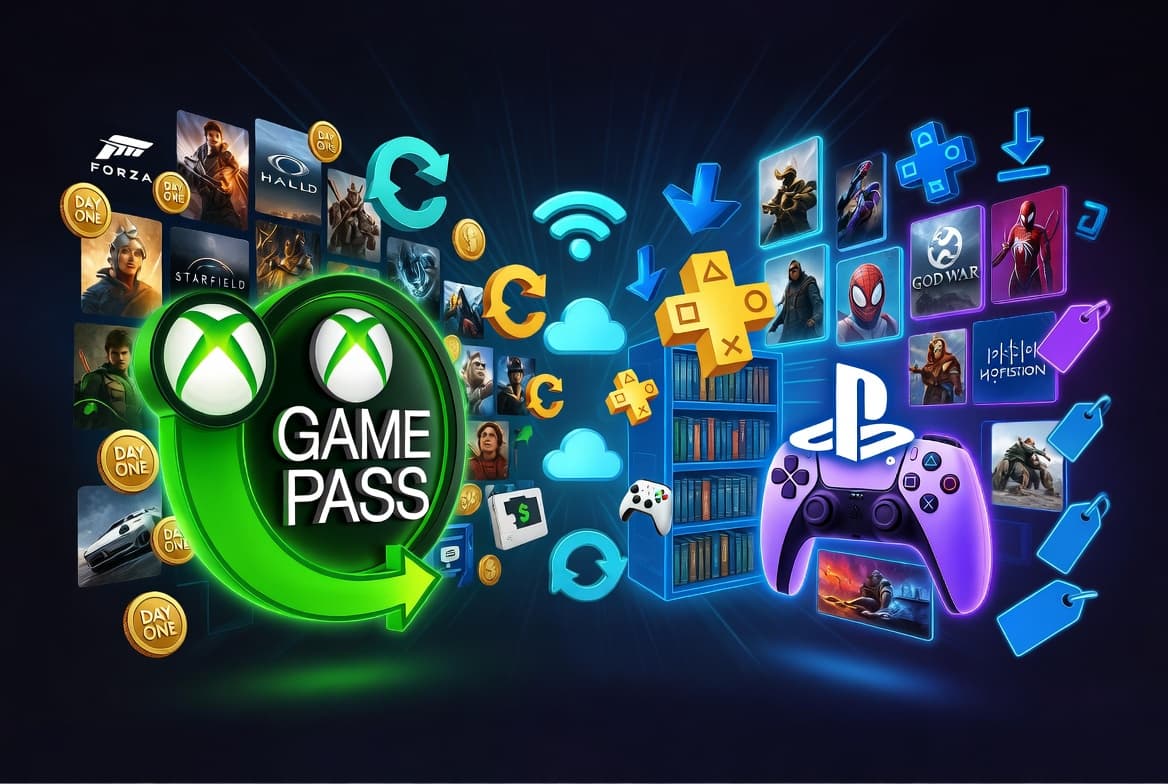
When every game costs nothing extra to try, the entire logic of how players discover, commit to, and abandon games changes. The subscription model isn't just a pricing shift — it's a behavioral one.
There's a specific kind of deliberation that used to happen before buying a game. You'd read reviews, watch gameplay footage, ask friends, check the Metacritic score, and then — after all of that — still hesitate at the checkout screen because seventy dollars is seventy dollars.
That deliberation is disappearing. And its disappearance is changing gaming in ways that are only beginning to become visible.
The Scale of What's Already Happened
Xbox Game Pass has over 34 million subscribers as of early 2026. PlayStation Plus, across its three tiers, has approximately 47 million. Together, that's over 80 million players who have access to libraries of hundreds of games for a flat monthly fee.
For context: the best-selling individual game releases in history — Red Dead Redemption 2, Elden Ring, The Last of Us — sold in the range of 20 to 25 million copies. The subscriber bases of these two services dwarf the audience of any single game ever made.
How the Psychology of Choice Changes
Behavioral economists have a concept called the paradox of choice — the idea that more options don't make decisions easier, they make them harder. Subscription gaming creates an extreme version of this problem.
When a game costs seventy dollars, the purchase itself creates commitment. You've invested real money, so you give the game a genuine chance. You push through a slow opening hour. You learn the mechanics. You get to the part where it becomes good.
When a game is free to try within a subscription, that commitment evaporates. Players now routinely download a game, play for twenty minutes, decide it hasn't immediately grabbed them, and move on to something else. Studios have internally reported significant drops in average session length for subscription titles compared to premium releases — players simply don't give games the same time to breathe.
This has concrete consequences for game design. A game that takes two hours to find its footing — a structure that produced some of the most acclaimed titles in history, including many JRPGs and slow-burn narrative games — is now at a significant disadvantage. The opening hour has always been important. Under the subscription model, it's existential.
What It Means for Discovery
The flip side is real and significant. Subscription services have dramatically lowered the barrier to trying games that players would never have purchased outright.
Hades is the most frequently cited example. Supergiant's roguelike received strong reviews at launch but sold modestly in its first months. When it appeared on Game Pass, millions of players tried it who would never have paid twenty-five dollars for a genre they weren't sure about. Many of them became enthusiastic converts who then purchased the game outright or bought it for friends on other platforms.
The same pattern repeated with Disco Elysium, Outer Wilds, and more recently with several smaller titles that found their largest audiences through subscription inclusion rather than direct sales. For certain kinds of games — unusual, genre-defying, hard to market through a trailer — subscriptions function as the most effective discovery mechanism ever created.
The Developer Economics Are Complicated
How much money a developer actually makes from Game Pass or PS Plus inclusion is one of the most contested questions in the current industry.
Microsoft pays developers a licensing fee for inclusion, plus bonuses tied to engagement metrics — hours played, number of players, completion rates. The exact figures are confidential, but developers who have spoken publicly describe outcomes that range from transformative to disappointing depending on the size of the studio and the nature of the deal.
For large publishers, subscription inclusion is primarily a marketing tool. EA and Ubisoft use their respective subscription services to drive awareness for franchises rather than to generate direct revenue from catalog titles. For small independent studios, a Game Pass deal can be the difference between a sustainable business and a studio closure — but it can also mean accepting a fixed payment that undervalues a breakout hit.
The structural concern is long-term. If subscription becomes the dominant distribution model, the unit economics of game development change fundamentally. Games are no longer valued by what individual players choose to pay for them. They're valued by how much time subscribers spend with them — a metric that favors certain kinds of games and disadvantages others.
What Subscribers Actually Play
The data that has leaked or been disclosed from subscription services reveals a pattern that surprises people who think carefully about it.
Despite access to hundreds of games, the average Game Pass subscriber plays fewer than six titles per month. The top ten most-played games on the service at any given time account for the majority of total hours. Subscribers don't explore the catalog as broadly as the value proposition implies — they largely use the service to access a small number of games they already wanted to play, plus occasionally stumble onto something unexpected.
This means the subscription model hasn't fundamentally changed the dominance of major releases. Call of Duty on Game Pass is still Call of Duty. It still gets the overwhelming majority of subscriber attention. The catalog of three hundred smaller games is largely theoretical value for most subscribers — present, appreciated in principle, rarely explored in depth.
The Platform War Underneath
Subscriptions are not primarily about consumer value. They are about platform lock-in.
Microsoft's Game Pass strategy is explicitly designed to make Xbox the ecosystem players live in — not just the hardware they own. If your game library, your saves, your subscription, and your social graph are all inside the Xbox ecosystem, switching to PlayStation becomes costly in ways that go beyond money. You leave things behind.
Sony understands this, which is why PlayStation Plus has been aggressively expanded despite Sony's historical preference for premium game sales. Not offering a subscription service isn't an option anymore — the question is only how to structure it without cannibalizing day-one sales of first-party titles, which remain PlayStation's primary revenue driver.
The tension between these two objectives — subscription growth and premium sales — is the central strategic problem both companies are navigating in 2026, without a clean solution in sight.
Where This Ends Up
The most likely long-term outcome is a bifurcated market. Major releases from large publishers will continue to launch at full price, with subscription inclusion arriving months later as a catalog benefit. Smaller and mid-sized games will increasingly use day-one subscription inclusion as their primary release strategy, accepting the trade-off of lower per-unit revenue for dramatically higher reach.
What won't return is the pre-subscription psychology of game purchasing. A generation of players is now growing up with the assumption that games are something you access, not something you own. The deliberation, the commitment, the relationship between price and perceived value — all of it is being quietly dismantled.
Whether that's good for gaming depends almost entirely on who you ask, and what kind of games you think the medium should be making.