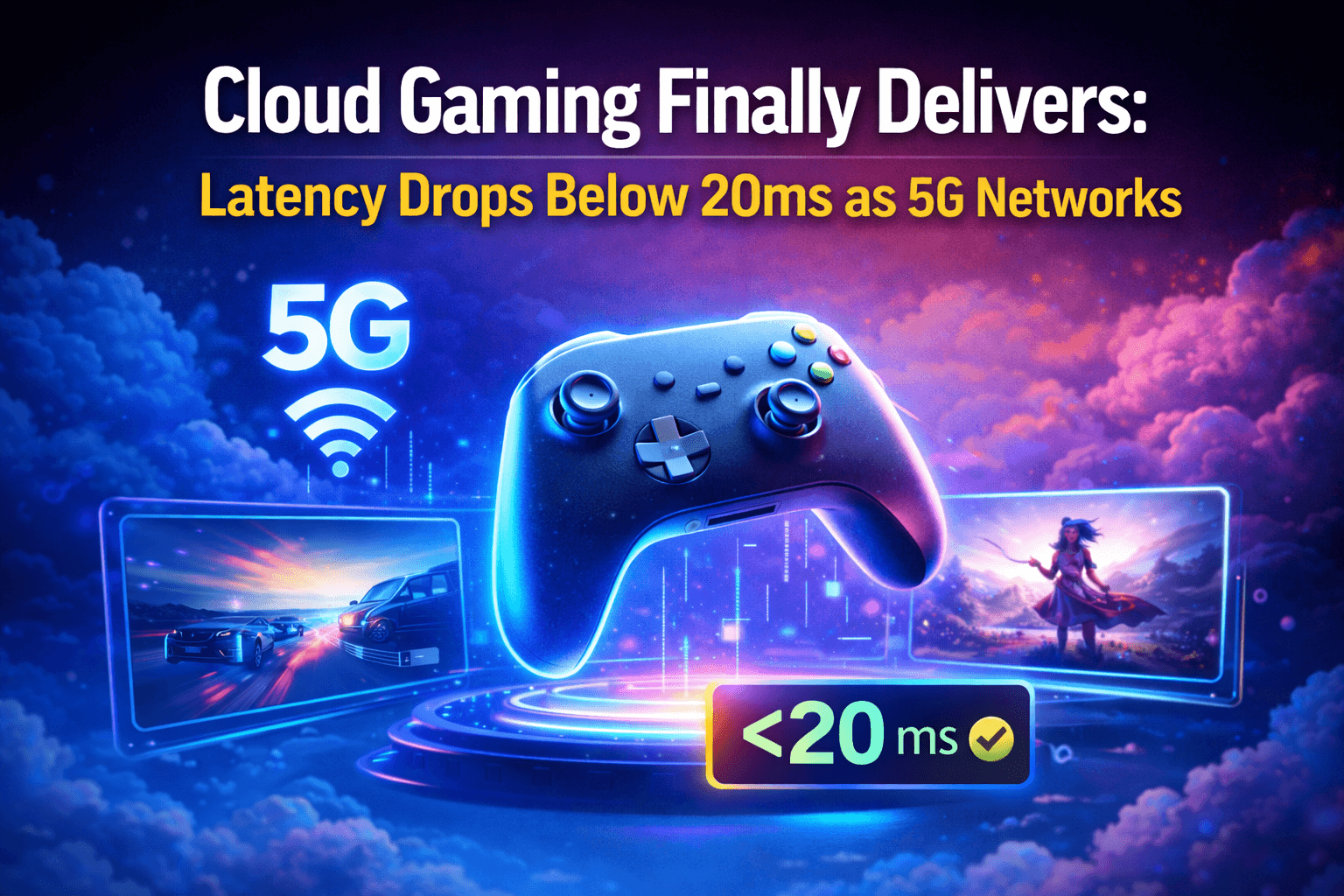
Cloud Gaming Finally Delivers: Latency Drops Below 20ms as 5G Networks Expand
The technology that was 'five years away' for the past decade has finally arrived. Here's what changed.
Cloud gaming has been gaming's perpetual promise—always on the horizon but never quite there. In 2025, that changed. Major breakthroughs in 5G infrastructure and edge computing have reduced latency to imperceptible levels, making cloud gaming finally viable for competitive play.
The Technical Breakthrough
Latency Improvements - 2023: 45-60ms average latency - 2024: 30-40ms average latency - 2025: 15-20ms average latency (comparable to local play)
What Enabled This?
1. Edge Computing: Cloud providers deployed thousands of micro-datacenters in major cities 2. 5G Standalone Networks: SA 5G networks provide consistent low latency 3. Advanced Compression: New codecs reduce bandwidth requirements by 40% 4. AI Prediction: Machine learning predicts player inputs, pre-rendering likely frames
Market Impact
The improvements translated to massive subscriber growth:
- Xbox Cloud Gaming: 15M subscribers (up from 8M in 2024) - GeForce NOW: 12M subscribers (doubled from 2024) - PlayStation Plus Premium: 9M cloud users - Amazon Luna: 5M subscribers (emerging player)
The Gaming Experience
We tested major cloud services with competitive multiplayer games:
Call of Duty: Modern Warfare III - Playable on Xbox Cloud Gaming with minimal lag - Pro players report "no noticeable difference" from local play - Tournament organizers exploring cloud gaming for events
Street Fighter 6 - Fighting game community (historically latency-sensitive) embraces cloud play - EVO 2025 featured cloud gaming demonstrations - Capcom testing cloud-only tournaments
Fortnite - Epic Games reports 30% of mobile players use cloud gaming - Cross-platform cloud play works seamlessly - Build battles feel responsive
Industry Shift
Major publishers are adjusting strategies:
Ubisoft announced Ubisoft+ will become cloud-first, with downloads optional. CEO Yves Guillemot stated: "We believe the future is platform-agnostic. Players should access our games anywhere."
EA expanded EA Play to include cloud streaming for all titles, including day-one releases.
Take-Two confirmed GTA 6 will support cloud gaming at launch, with cloud-exclusive features leveraging server-side processing.
The Console Question
Cloud gaming's maturation raises questions about future hardware:
- - Do consumers need $500 consoles if cloud works well?
- - Microsoft hints at "Xbox Streaming Stick" for 2026
- - Sony doubles down on PS6 hardware while expanding cloud
- - Nintendo remains hardware-focused with Switch 2
Remaining Challenges
1. Data Caps: ISPs throttling heavy users 2. Rural Access: Fiber/5G not universal 3. Game Ownership: Concerns about always-online requirements 4. Subscription Fatigue: Too many services competing
The Verdict
For the first time, cloud gaming is a legitimate alternative to local hardware. It won't replace consoles overnight, but the option now exists for players who want instant access without downloads, updates, or expensive hardware.
The decade of "cloud gaming is coming" is over. Cloud gaming is here.