6 Best Free Puzzle Games to Play in Your Browser
Discover six free browser puzzle games featuring drawing, pins, stealth, territory, physics, and route planning—no installation required.
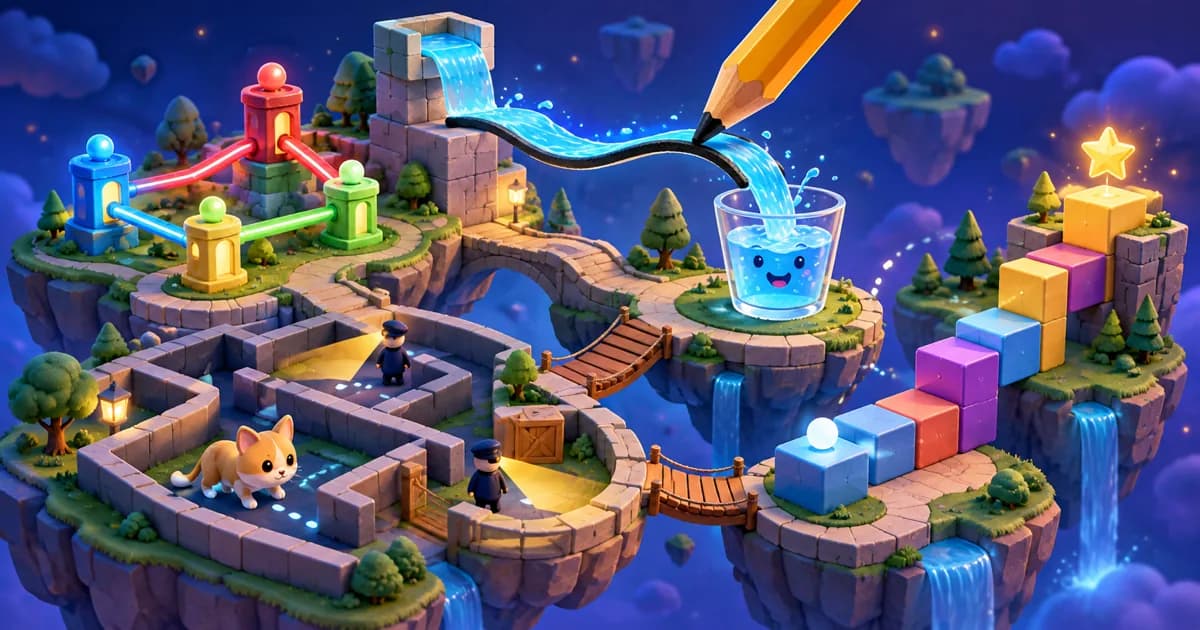
A good browser puzzle game introduces a clear problem, gives you a small set of tools, and lets experimentation teach the rest. You should be able to begin without a manual, yet still find enough variation to make later stages interesting. The strongest examples also respect short sessions: one level can feel complete, while the next remains ready whenever you return.
These six games approach problem-solving from different directions. Happy Glass uses drawing and physics, Homescapes revolves around pin order, City Takeover turns numbers into strategy, Cat Escape makes movement a stealth puzzle, Bridge Race mixes planning with competition, and Stack Ball asks for restraint inside an action game.
1. Happy Glass: Draw a Solution
Happy Glass presents an empty glass and a stream of water. Hold and drag to draw a line, release to start the simulation, and guide enough water into the glass. Your drawing becomes part of the physical scene, which means it can form a ramp, bridge, wall, or support.
Study the expected water path before drawing. A short line placed at the correct angle is often more stable than an elaborate structure. Remember that gravity affects both the water and the object you create. If a solution almost works, adjust one section rather than replacing the entire idea. The game rewards efficient thinking as much as completion.
2. Homescapes: Solve the Pin Order
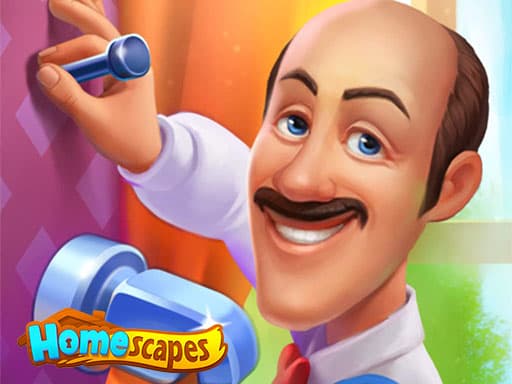
Homescapes builds each puzzle around removable pins, useful objects, hazards, and a character who needs a safe outcome. Click or tap one pin at a time and observe how the scene changes. The important question is not simply which pin can move, but which pin must move first.
Trace cause and effect from the goal backward. Identify the immediate danger, decide what can neutralize it, and only then release the path toward the objective. Moving a tempting pin too early can make the stage impossible. Pause after every action; the new arrangement may require a different plan than the one you imagined at the start.
3. City Takeover: Numbers Become a Map
City Takeover asks you to connect buildings and send units along the resulting routes. Neutral towers expand your network, friendly connections reinforce weak points, and enemy buildings require enough pressure to capture. The controls are simple—drag from one building to another—but the order of expansion shapes the entire stage.
Capture nearby neutral locations before committing to a distant attack. More buildings create more unit flow, but too many routes can spread that flow thin. Watch for a threatened tower and redirect support before it changes sides. The puzzle lies in balancing growth, defense, and timing rather than executing fast inputs.
4. Cat Escape: Read the Patrol Pattern
Cat Escape turns every room into a small stealth problem. Drag to guide the cat toward the exit while staying outside guard vision. Furniture, corners, and safe areas interrupt sightlines, so progress comes from observing the room before moving through it.
Wait for a guard to face away, move to the next reliable hiding point, and reassess. Trying to cross several exposed spaces in one motion creates unnecessary risk. If two patrols overlap, look for a position where you can wait safely between them. The cute presentation is approachable, but later layouts reward genuine route planning.
5. Bridge Race: Plan While Everyone Moves
Bridge Race combines a color-collection challenge with a race to construct stairs. Gather boards matching your color, carry them to an unfinished route, and spend them automatically as you climb. Other racers are pursuing the same objective, which makes efficiency important.
Do not approach the staircase with only a few boards if a fuller stack is available nearby. Repeatedly returning to collect wastes time, but holding too many can also expose a long investment to interference. Watch which staircase is least crowded and choose a collection loop that ends close to it. The puzzle changes continuously because opponents reshape the best route.
6. Stack Ball: The Puzzle Is Knowing When to Stop
Stack Ball appears to be pure action, but every rotating layer creates a timing problem. Hold to smash through safe colored platforms and release before the ball reaches a dangerous black section. Long combinations feel powerful, yet continuing for one layer too many ends the run.
Look below the current impact point instead of watching only the platform being broken. Release early when a dark section approaches and wait for rotation to reveal a better path. The game rewards controlled bursts, not permanent pressure. That makes restraint the central puzzle and explains why repeated attempts remain satisfying.
Choose the Puzzle Style That Fits Your Mood
Happy Glass is the most creative because one drawing can solve a problem in several ways. Homescapes suits players who enjoy ordered logic. City Takeover provides broader strategic decisions, while Cat Escape focuses on observation. Bridge Race adds active opponents, and Stack Ball delivers a quick timing challenge.
When stuck, change the question you are asking. Instead of wondering why a solution failed, identify the first moment when the outcome became unavoidable. That moment usually reveals the useful adjustment: a different line angle, a delayed pin, a safer route, or an earlier release. Browser puzzles are ideal for this kind of rapid experiment because restarting is quick and every attempt provides visible feedback.
Play Games From This Article
Try the games mentioned above directly in your browser—no download required.